
Resources
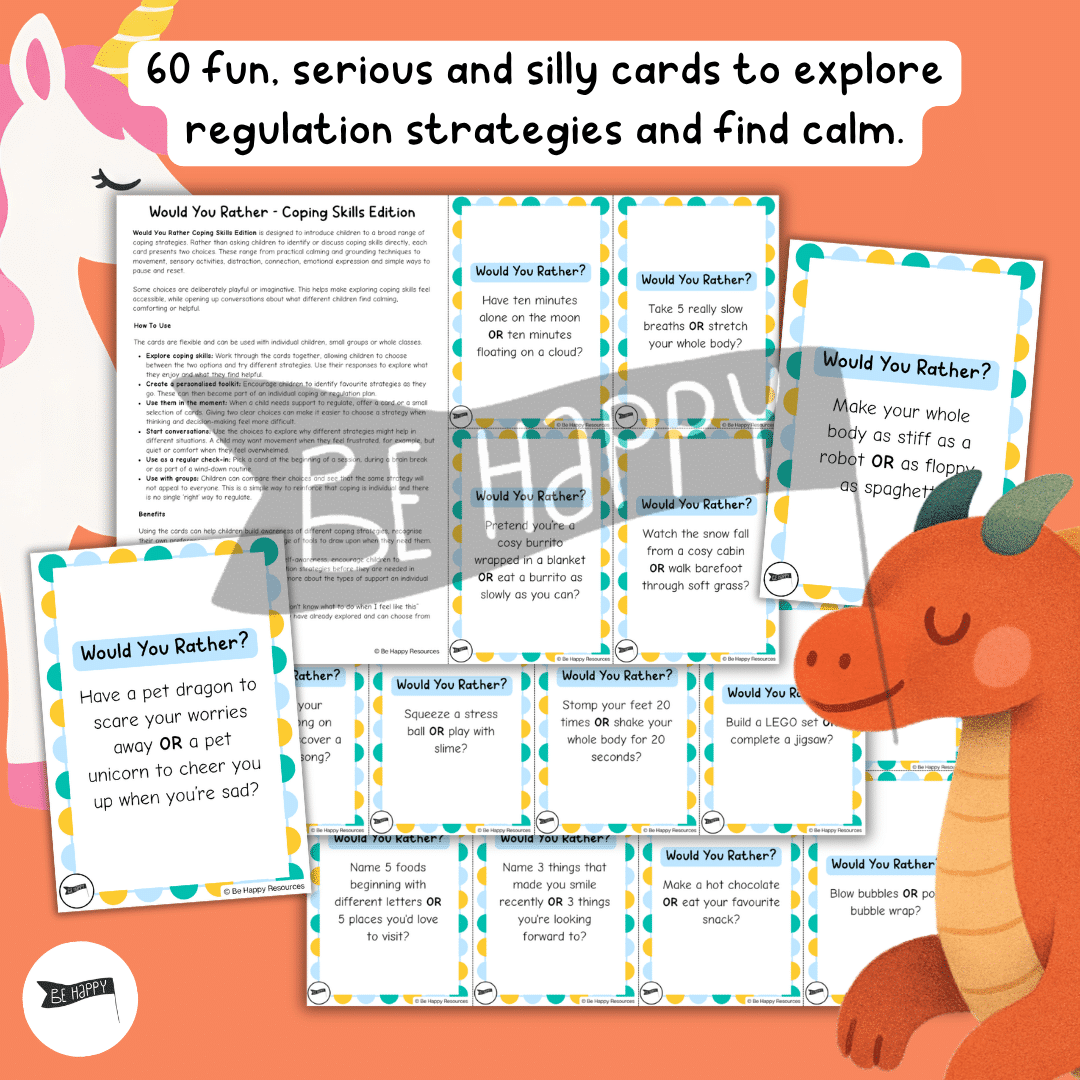
Would You Rather? – Coping Skills Edition – Explore Calming Strategies That Work!
Would You Rather? Coping Skills makes exploring coping strategies fun, easy and completely pressure-free.
With 60 fun, serious and silly choices, children can discover new ways to calm, cope and regulate while working out which strategies suit them best.
Use them in the moment, in lessons or during therapy sessions. Discuss them, explore them, try them out or simply pick a card when a child needs a strategy. There are so many ways to use these cards!
Member Account Includes
- Access over 800 downloadable mental health resources for children and teens
- Resource packs, activities, games, worksheets, teaching resources and more
- Seasonal themed resources
- Unlimited downloads
- Request your own resources
- Cancel anytime
Resource Info
Would You Rather? Coping Skills Cards - Find Strategies That Work!
60 Fun, Serious & Silly Cards to Explore Coping Skills With Children
Would You Rather? Coping Skills is a set of 60 engaging discussion cards helping children explore different ways to cope, calm, regulate and reset when things feel difficult.
Each card gives children two different coping strategies to choose between. Some are calming, some involve movement, some encourage grounding or asking for help, and others are deliberately silly! Children simply choose which they would rather try and why.
There are no right or wrong answers, the aim is to introduce children to a wide range of coping strategies.
How to Use
Pick a card, read the two choices and ask:
Which would you rather?
Children can choose their favourite and explain their reasoning, or simply make their choice without having to discuss a personal experience.
Extend the conversation with questions such as:
- Why did you choose that one?
- Have you tried either of these before?
- When might this strategy be useful?
- Do you think everyone would choose the same?
- Is there a situation where you might choose the other one?
- What else could you try?
Use a handful of cards as a quick session starter or work through the pack over time to help children build up a much bigger bank of strategies they can draw upon.
Fun, Serious & Silly!
Coping skills don't always need to be explored through serious conversations.
The pack deliberately mixes practical strategies with playful and imaginative choices, making it much easier to get children engaged in the discussion.
The simple Would You Rather format also removes some of the pressure of direct questions such as “What do you do when you're angry?” or “How do you cope when you're worried?”
Instead, children get to choose, compare, laugh, discuss and explore.
So Many Ways to Use
These cards aren't only for talking about coping skills. They can also become a practical bank of strategies children can reach for when they actually need help calming, regulating or resetting.
Use Them as Discussion Cards
Pick a card and ask children which they would rather choose and why.
The simple two-choice format can open up conversations about coping without putting children on the spot or asking them to disclose how they're feeling.
Try questions such as:
- Which would you rather try?
- Why does that one appeal to you?
- When might it be helpful?
- Have you tried either before?
- Would everyone choose the same?
- Could your answer change depending on how you were feeling?
- Is there another strategy you'd choose instead?
Use just one or two cards as a quick conversation starter, or explore several during a dedicated coping skills or emotional regulation session.
Use Them In the Moment
This is where the cards can become really useful.
When a child is feeling worried, frustrated, overwhelmed, restless or dysregulated, choosing what to do can be difficult.
Rather than asking “What do you need?” or offering a long list of strategies, give them a card with two simple options:
Which would you rather try?
They only need to make one small choice.
Let them pick a card at random, offer a few cards you think might be appropriate, or spread several out and let the child choose.
Once they've chosen, try the strategy together.
Over time, children can become more familiar with the different options and build up a bigger repertoire of things they know they can try when they need them.
Create a Personal Coping Skills Collection
As you work through the cards, sort them into piles such as:
I'd try this!
Maybe...
Not for me!
Or ask children to collect their favourite choices from each card.
This can help identify patterns. Does the child regularly choose movement? Do they prefer quiet and grounding? Are they drawn to distraction, sensory activities or talking to someone?
Use their favourites to create a personalised list or coping toolbox they can refer back to.
Try the Choices for Real
Pick a card and actually test the strategies.
Try option one, then option two. Afterwards ask:
Which worked better for you?
Children might be surprised by something they didn't expect to enjoy, and it helps move coping skills from abstract ideas into strategies they've actually experienced.
Use Them as a Session Starter
Choose one card at the beginning of an ELSA, nurture, counselling or pastoral session.
It's a quick, playful way to settle into the session and can naturally lead into conversations about emotions, coping and individual preferences.
Create a Coping Skills Pick-Me-Up Station
Keep the cards somewhere children can access them when they need a little help regulating.
A child could:
Pick a card → choose one of the two strategies → give it a try.
This could work brilliantly in a calm corner, regulation station, nurture room, pastoral space or ELSA area.
Get Children Moving
Turn the cards into a whole-class movement activity.
Read both choices aloud and designate one side of the room for each answer. Children move to the side representing the strategy they'd rather choose.
Look around. Did everyone choose the same?
It's an easy visual demonstration that different things work for different people.
Pick a Coping Skill of the Day
Choose a card and let the class vote for one of the two strategies.
Try the winning strategy together as a brain break, transition activity or calming moment, gradually introducing children to lots of different techniques.
Use Them One-to-One
The cards are particularly useful for children who find direct questions about feelings difficult.
Instead of:
“What helps you when you're overwhelmed?”
you can start with:
“Which of these two would you rather try?”
The choice gives the conversation somewhere concrete to begin.
Build Them Into Emotional Regulation Work
Use the cards alongside work on recognising emotions and body signals.
For example:
How might your body tell you that you need a coping strategy?
Would you choose the same strategy for anger and worry?
What might help when you have lots of energy?
What might help when your thoughts won't slow down?
This helps children move beyond simply knowing coping strategies to thinking about when and why they might use them.
Use Them Again and Again
The cards don't need to be worked through once and finished.
A child's choices may change depending on their mood, situation, environment and what they need that day.
A strategy they dismiss the first time might become a favourite later.
Keep the pack accessible and let children return to it whenever they need an idea, a conversation starter or simply two options for what to try next.
A Simple Formula
You could even pull this out visually on the product page:
Feeling stuck? → Pick a card → Choose one → Give it a go!
That really sells that these aren't just discussion cards about coping skills. They can become a usable tool children reach for in the actual moments those coping skills are needed.
Features
- 60 Would You Rather? cards
- Mix of fun, serious and silly choices
- Explores a wide variety of coping and regulation strategies
- Includes calming, grounding, movement, distraction, sensory and help-seeking ideas
- Simple two-choice format
- No right or wrong answers
- Can be used individually, one-to-one, in small groups or as a whole class
- Easy to use with minimal preparation
- Suitable for repeated use across multiple sessions
- Great for ELSA, nurture, pastoral support, emotional regulation work, counselling, therapy, SEND and PSHE
- Can be used as discussion cards, movement activities or quick session starters
Benefits
- Introduces children to a wider range of coping strategies
- Helps children discover what works for them
- Builds a personal bank of ideas to try when things feel difficult
- Encourages self-awareness and reflection
- Develops understanding that different people may need different ways to regulate
- Opens up conversations about coping without requiring personal disclosure
- Encourages children to explain their choices and consider alternatives
- Supports communication and decision-making skills
- Makes coping-skills work feel interactive and playful
- Helps move children beyond relying on the same one or two familiar strategies
- Gives practitioners an easy way to explore a child's preferences and individual needs
Perfect For
ELSA Sessions • Emotional Regulation • Coping Skills Work • Nurture Groups • Pastoral Support • Counselling & Therapy • SEND • PSHE • Wellbeing Sessions • One-to-One Work • Small Groups • Classroom Discussions
Would You Rather? Coping Skills makes exploring coping strategies fun, easy and completely pressure-free. With 60 fun, serious and silly choices, children can discover new ways to calm, cope and regulate while working out which strategies suit them best.


Our
Members Include


